
$HBMX
AI runs on memory.
The Tuttle Capital Concentrated Memory Stack ETF: The actively managed, concentrated ETF for the memory layer of the AI build.

The Gap
$HBMX
A Potential Trade With The Broader AI Theme
The headlines follow processors. The capital has been moving into memory.
“Memory is taking over Hyperscaler CapEx. We estimate it hits 30% in CY26 and moves higher in CY27. That’s a near-4x shift in just four years.”
SemiAnalysis, 2026 [1]
Memory comes in two main forms, DRAM for working memory and NAND for storage. The category most exposed to the AI build is high-bandwidth memory (HBM), a stacked DRAM architecture that feeds AI accelerators.
Investors who want memory exposure face a structural problem. Broad semiconductor ETFs may dilute memory among dozens of unrelated names. And the more focused memory vehicles that exist tend to concentrate heavily in a small number of names — including large Korean conglomerates whose revenues span consumer electronics, displays, and appliances alongside their memory operations.
That’s the gap HBMX aims to close.

The Shift
$HBMX
Why the Memory Layer Looks Different Now
The shift in capital allocation reflects three deeper changes in the memory layer itself.
Memory Became Strategic
High-bandwidth memory, 3D stacking, and advanced packaging changed the role of memory inside AI systems. This is no longer interchangeable supply. It’s capacity-constrained, qualification-driven, and increasingly central to performance.
The Cycle Changed
Memory used to follow demand. Now it helps define it. What was once a commoditized input is becoming a critical layer of AI infrastructure.
The Stack Is Bigger Than Chips
Memory is the entry point. The ecosystem extends into packaging, substrates, interconnects, materials, and testing. The opportunity is wider than most investors realize.
The Fund
$HBMX
Built for the Layer Supporting the Build-Out
HBMX isn’t built around AI headlines. It’s built around what the build-out runs on.
The pattern repeats across AI infrastructure: wherever there's a bottleneck, capital tends to concentrate. The GPU displaced the CPU. Now AI workloads are bumping up against memory. HBMX is built around that observation — not a prediction about the next breakthrough, but a view on what already has to scale.
For investors who want to trade the memory cycle, concentrated single-name vehicles exist. HBMX is built for something different — durable, portfolio-grade exposure across the memory stack, with less concentration risk and more of the ecosystem.
The Stack
$HBMX
Inside HBMX:
The Memory Stack
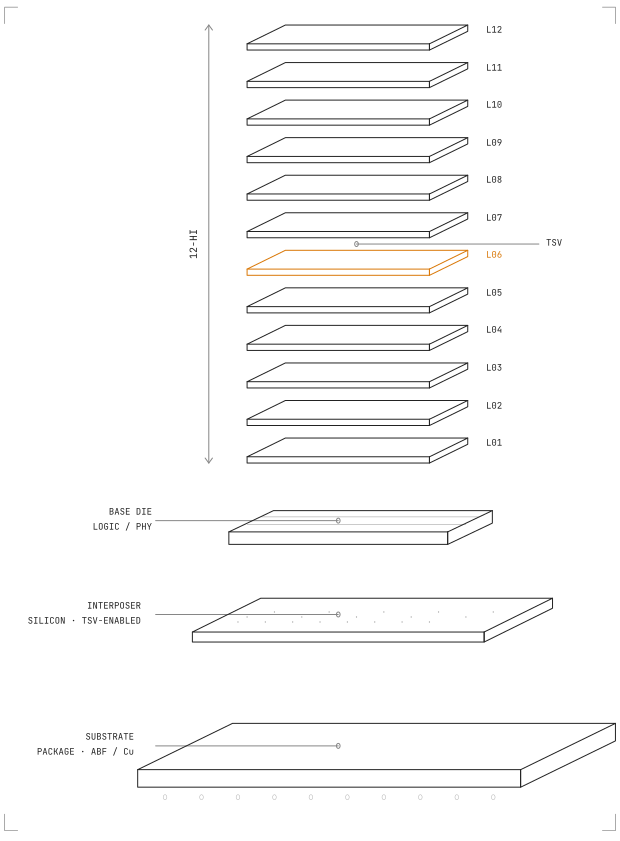
The Memory Stack spans multiple layers of the semiconductor ecosystem:
Memory Manufacturing.
DRAM, NAND, and HBM production.
Advanced Packaging
2.5D and 3D integration, TSV, chiplets.
OSAT Services
Assembly and testing tied to memory production.
Substrates and Interconnects.
Materials enabling signal and power delivery.
Test and Metrology.
Inspection and measurement systems.
Qualifying Semis.
Companies meeting the revenue threshold or strategic exposure criteria.
The Build
$HBMX
HBMX’s Design
Three principles hold the portfolio together.
Concentrated by Design
20 to 35 holdings. Built to express a view, not dilute it.
Active Across the Stack
The memory ecosystem is cyclical and uneven. Active positioning allows the Advisor to adjust exposure across segments.
Pure-Play Discipline
A defined revenue threshold ensures meaningful exposure to the thesis.
Where It Fits
$HBMX
Where HBMX
Fits in a Portfolio
Investors may already own semiconductor exposure, usually through a broad-basket ETF or a few mega-cap names. HBMX is not designed to replace that exposure. It’s designed to add what those vehicles typically don’t.
A Note on Geography
HBMX is built to sit alongside broad semiconductor or technology exposure, not to substitute for it.
Investors looking for dedicated, concentrated, actively managed exposure to the memory layer of the AI build can use HBMX as a satellite position within a diversified portfolio.
SK Hynix and Samsung — two of the largest names in global memory — aren’t directly listed on U.S. exchanges. Accessing them typically means taking on Korean market exposure through country ETFs, alongside unrelated businesses and index weights you didn’t sign up for. HBMX holds U.S.-listed, developed-market securities. The memory thesis, without the Korea ETF baggage.
The Close
$HBMX
The processor story gets the attention, but the memory layer may carry an increasing share of the workload. HBMX was built to reflect that.

The Founder
$HBMX
About Matthew Tuttle
Tuttle Capital Management
Matthew Tuttle is CEO of Tuttle Capital Management, an independent ETF issuer with over two decades in the investment industry. Tuttle Capital’s approach is built around a single idea: find where a macro theme creates a specific, structural bottleneck — then build a focused, actively managed vehicle around it. HBMX applies that approach to the memory layer of the AI build.
Contact
$HBMX
Ready to go deeper?
If you’d like to discuss how HBMX fits within a portfolio allocation — or just have questions about the fund — we respond to every inquiry.
Disclosures
An investment in the Fund entails risk. The Fund may not achieve its leveraged investment objective and there is a risk that you could lose all of your money invested in the Fund. The Fund is not a complete investment program. In addition, the Fund presents risks not traditionally associated with other mutual funds and ETFs. It is important that investors closely review all of the risks listed below and understand them before making an investment in the Fund.
Market Risk. The Fund’s investments are subject to changes in general economic conditions, overall market fluctuations and the risks inherent in investment in securities markets. Investment markets can be volatile and the prices of securities may decline due to factors affecting securities markets generally or particular industries represented in the markets. Local, regional or global events such as war, acts of terrorism, the spread of infectious illness, social unrest, natural disasters or other events could have a significant negative impact on the Fund and its investments.
Semiconductor and Technology Industry Risk. Memory Stack Companies are generally in the semiconductor and/or technology industries, which are subject to rapid technological change, product obsolescence, short product cycles, pricing pressure, high research and development costs and significant capital expenditures. These companies face intense competition and may be highly dependent on intellectual property, supply chain stability and manufacturing capacity. Semiconductor companies may be particularly sensitive to supply and demand imbalances, inventory corrections, capacity expansions and contractions, and changes in end-market demand. The performance of companies in this industry may be highly volatile.
Memory Semiconductor Risk (DRAM/NAND/HBM). Companies exposed to memory semiconductors, including DRAM, NAND and high-bandwidth memory (“HBM”), are often affected by cyclical pricing, rapid shifts in supply and demand conditions and customer concentration. Periods of oversupply may result in significant pricing declines and margin compression. Growth in HBM and other advanced memory technologies may depend on adoption of specific compute architectures, packaging technologies and the pace of artificial intelligence infrastructure deployment. If demand for AI-driven computing or related technologies slows or fails to meet expectations, companies exposed to HBM and related memory products may be adversely affected.
Advanced Packaging and OSAT Risk. Companies involved in advanced semiconductor packaging, outsourced semiconductor assembly and test (“OSAT”), substrates, interconnect technologies and related equipment may be affected by technological transitions, qualification cycles, customer concentration and capital spending patterns of semiconductor manufacturers and foundries. Demand for advanced packaging solutions may fluctuate based on product cycles and end-market demand, and such companies may face execution risks associated with scaling new packaging technologies.
Concentration Risk. The Fund focuses on a relatively narrow theme within the semiconductor ecosystem. As a result, the Fund may be more volatile than funds with more diversified portfolios and may be adversely affected by developments impacting Memory Stack Companies or the semiconductor industry generally. The Fund’s performance may be closely tied to trends affecting memory semiconductor markets and related technologies.
Active Management Risk. The Fund is actively managed and does not seek to track an index. The Fund’s performance depends on the Adviser’s ability to identify and select investments that achieve the Fund’s investment objective. The Adviser’s judgments about the attractiveness, value and potential appreciation of Memory Stack Companies may prove to be incorrect.
Equity Securities Risk. The Fund invests primarily in equity securities, which are subject to market risks that may cause their prices to fluctuate over time. The value of equity securities may decline due to general market conditions, economic trends or factors affecting specific issuers or industries. Equity markets historically have experienced periods of significant volatility.
Micro-, Small- and Mid-Capitalization Company Risk. The Fund may invest in companies of any market capitalization, including micro-, small- and mid-capitalization companies. These companies may be more volatile, less liquid and more susceptible to adverse developments than larger companies. They may have more limited product lines, operating histories and financial resources.
Foreign Securities Risk. The Fund may invest in securities of non-U.S. issuers. Investments in foreign securities involve risks not typically associated with U.S. securities, including differences in accounting standards, less publicly available information, less liquidity, political instability, economic uncertainty, and potential government intervention. Foreign markets may be more volatile than U.S. markets.
Emerging Markets Risk. To the extent the Fund invests in emerging markets, such investments involve additional risks, including less developed legal and regulatory systems, greater market volatility, lower trading volumes and greater political and economic instability.
Depositary Receipts Risk. Depositary receipts, including ADRs and GDRs, are subject to many of the risks associated with investing directly in foreign securities, including political and currency risks. Depositary receipts may not track the price of the underlying foreign securities perfectly.
Derivatives Risk. The Fund may use derivatives, including total return swaps, options and other instruments, to obtain exposure to Memory Stack Investments or to equitize cash positions. Derivatives are financial instruments that derive their value from an underlying reference asset. Investing in derivatives may expose the Fund to risks in addition to, and greater than, those associated with directly investing in securities, including market risk, leverage risk, imperfect correlation, counterparty risk, liquidity risk, valuation risk and legal or regulatory risk. Because derivatives may require only a limited initial investment relative to their economic exposure, losses may exceed the amount initially invested. The use of derivatives may increase the volatility of the Fund’s returns.
Swap Agreements Risk. The Fund expects to use swap agreements to achieve its investment objective. Swap agreements are generally entered into with financial institutions for a specified period and are typically traded over-the-counter. The Fund bears the risk that a counterparty to a swap agreement may default or fail to perform its obligations. Over-the-counter swaps may be less liquid than exchange-traded instruments and may be more difficult to value. Changes in interest rates and other market conditions may increase the costs associated with swap agreements and reduce the Fund’s returns.
Cash Transaction Risk. The Fund intends to effect creations and redemptions for cash rather than for in-kind securities. As a result, the Fund may not be tax efficient and may incur brokerage costs related to buying and selling securities to achieve its investment objective thus incurring additional expenses than if it had effected creations and redemptions in kind. To the extent that such costs are not offset by transaction fees paid by an authorized participant, the Fund may bear such costs, which will decrease the Fund’s net asset value.
ETF Trading Risk. Shares of the Fund are listed for trading on an exchange and may be bought and sold in the secondary market at market prices. The market price of Shares may be above (premium) or below (discount) the Fund’s net asset value (“NAV”). There can be no guarantee that an active trading market for Shares will develop or be maintained, or that the Shares will trade with any volume, or at all.
Cyber Security Risk. The Fund is susceptible to operational risks through breaches in cyber security. A breach in cyber security refers to both intentional and unintentional events that may cause the Fund to lose proprietary information, suffer data corruption or lose operational capacity. Such events could cause the Fund to incur regulatory penalties, reputational damage, additional compliance costs associated with corrective measures and/or financial loss. Cyber security breaches may involve unauthorized access to the Fund’s digital information systems through hacking or malicious software coding but may also result from outside attacks such as denial-of-service attacks through efforts to make network services unavailable to intended users. In addition, cyber security breaches of the issuers of securities in which the Fund invests or the Fund’s third-party service providers, such as its administrator, transfer agent, custodian, or sub-advisor, as applicable, can also subject the Fund to many of the same risks associated with direct cyber security breaches. Although the Fund has established risk management systems designed to reduce the risks associated with cyber security, there is no guarantee that such efforts will succeed, especially because the Fund does not directly control the cyber security systems of issuers or third-party service providers.
Tax Risk. In order to qualify for the special tax treatment accorded a regulated investment company (“RIC”) and its shareholders, the Fund must derive at least 90% of its gross income for each taxable year from “qualifying income,” meet certain asset diversification tests at the end of each taxable quarter, and meet annual distribution requirements. The Fund’s pursuit of its investment strategy will potentially be limited by the Fund’s intention to qualify for such treatment and could adversely affect the Fund’s ability to so qualify. The Fund may make certain investments, the treatment of which for these purposes is unclear. If, in any year, the Fund were to fail to qualify for the special tax treatment accorded a RIC and its shareholders, and were ineligible to or were not to cure such failure, the Fund would be taxed in the same manner as an ordinary corporation subject to U.S. federal income tax on all its income at the fund level. The resulting taxes could substantially reduce the Fund’s net assets and the amount of income available for distribution. In addition, in order to requalify for taxation as a RIC, the Fund could be required to recognize unrealized gains, pay substantial taxes and interest, and make certain distributions. Please see the section entitled “Taxes” in the Statement of Additional Information for more information.
ETF Risks. The Fund is an exchange-traded fund, and, as a result of an ETF’s structure, it is exposed to the following risks:
- Authorized Participants, Market Makers, and Liquidity Providers Limitation Risk. The Fund has a limited number of financial institutions that may act as Authorized Participants (“APs”). In addition, there may be a limited number of market makers and/or liquidity providers in the marketplace. To the extent either of the following events occur, Shares may trade at a material discount to NAV and possibly face delisting: (i) APs exit the business or otherwise become unable to process creation and/or redemption orders and no other APs step forward to perform these services, or (ii) market makers and/or liquidity providers exit the business or significantly reduce their business activities and no other entities step forward to perform their functions.
- Cash Redemption Risk. The Fund intends to redeem Shares for cash or to otherwise include cash as part of its redemption proceeds. The Fund may be required to sell or unwind portfolio investments to obtain the cash needed to distribute redemption proceeds. This may cause the Fund to recognize a capital gain that it might not have recognized if it had made a redemption in-kind. As a result, the Fund may pay out higher annual capital gain distributions than if the in-kind redemption process was used.
- Costs of Buying or Selling Shares. Due to the costs of buying or selling Shares, including brokerage commissions imposed by brokers and bid/ask spreads, frequent trading of Shares may significantly reduce investment results and an investment in Shares may not be advisable for investors who anticipate regularly making small investments.
- Shares May Trade at Prices Other Than NAV. As with all ETFs, Shares may be bought and sold in the secondary market at market prices. Although it is expected that the market price of Shares will approximate the Fund’s NAV, there may be times when the market price of Shares is more than the NAV intra-day (premium) or less than the NAV intra-day (discount) due to supply and demand of Shares or during periods of market volatility. This risk is heightened in times of market volatility and volatility in the Fund’s portfolio holdings, periods of steep market declines, and periods when there is limited trading activity for Shares in the secondary market, in which case such premiums or discounts may be significant. If an investor purchases Shares at a time when the market price is at a premium to the NAV of the Shares or sells at a time when the market price is at a discount to the NAV of the Shares, then the investor may sustain losses that are in addition to any losses caused by a decrease in NAV.
- Trading. Although Shares are listed for trading on a national securities exchange, and may be traded on other U.S. exchanges, there can be no assurance that Shares will trade with any volume, or at all, on any stock exchange. In stressed market conditions, the liquidity of Shares may begin to mirror the liquidity of the Fund’s underlying portfolio holdings, which can be significantly less liquid than Fund Shares.
Non-Diversification Risk. The Fund is classified as “non-diversified” under the Investment Company Act of 1940, as amended. This means it has the ability to invest a relatively high percentage of its assets in the securities of a small number of issuers or in financial instruments with a single counterparty or a few counterparties. This may increase the Fund’s volatility and increase the risk that the Fund’s performance will decline based on the performance of a single issuer or the credit of a single counterparty and make the Fund more susceptible to risks associated with a single economic, political, or regulatory occurrence than a diversified fund.
New Fund Risk. As of the date of this prospectus, the Fund has no operating history and currently has fewer assets than larger funds. Like other new funds, large inflows and outflows may impact the Fund’s market exposure for limited periods of time. This impact may be positive or negative, depending on the direction of market movement during the period affected.
The Shares will change in value, and you could lose money by investing in the Fund. The Fund may not achieve its investment objective.
Investors should consider the investment objectives, risks, charges, and expenses carefully before investing. For a prospectus with this and other information about the fund, please call (833) 759-6110. Please read the prospectus carefully before investing.
Distributor: Foreside Fund Services